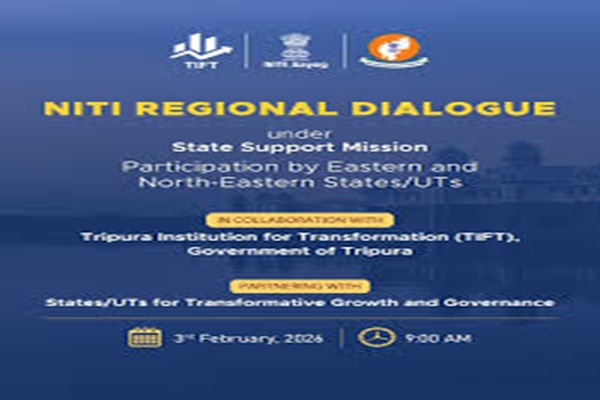
NITI Aayog, in collaboration with the Tripura Institution for Transformation (TIFT), Government of Tripura successfully conducted the 3rd Regional Dialogue under the State Support Mission (SSM) on 3rd February 2026 in Agartala, Tripura for the 14 Eastern and North-Eastern States/UTs. This regional dialogue is the third in a series under the Central Sector Scheme to foster structured engagement between NITI Aayog and States/UTs through State Institutions for Transformation (SITs). The objective of this dialogue was to bring together States and UTs to share their experience on SSM initiatives and learn from each other. It emphasised the pivotal role of State Institutions for Transformation (SIT) in guiding State visions, advancing reforms and aligning with the national aspiration of Viksit Bharat @2047.
The first Regional Dialogue on SSM was held in Dehradun, Uttarakhand on 2nd June 2025, for the 10 northern States/UTs. This was followed by the second regional Dialogue which was held in Pune, Maharashtra on 25th September, 2025 which saw participation from 11 States/UTs.
The inaugural session was graced by Prof. (Dr.) Manik Saha, Chief Minister, Tripura, Shri Jitendra Kumar Sinha, Chief Secretary, Government of Tripura, Shri Raj Shekhar Joshi, Vice Chairperson, SETU Aayog, Government of Uttarakhand, Shri Rohit Kumar, Additional Secretary (Virtual) & Programme Director (States), NITI Aayog, Shri Kiran Gitte, CEO, TIFT and Shri K.S. Rejimon, Joint Secretary & Mission Director (SSM), NITI Aayog
The deliberations across sessions reflected a shared recognition among States of the State Institutions for Transformation (SITs) as central platforms for supporting reform implementation and inter-State learning under the State Support Mission, while highlighting the need to consolidate early institutional gains and strengthen their operational effectiveness going forward.
The sessions began with a presentation on NITI for States: Towards cooperative Federalism by SSM, NITI Aayog which highlighted the key components of the scheme, various ongoing initiatives such as NITI for States platform to promote cross learning among States/UTs, Viksit Bharat Strategy Room to promote data driven decision making and how these tools can be leveraged by the state.
The session on the Role of SITs in Achieving State and National Goals discussed how SITs are evolving into multi-disciplinary hubs that go beyond traditional planning functions to encompass long-term visioning, evidence-based policy formulation and outcome-focused governance. The deliberations focused on strengthening institutional mechanisms for vision-led and data-driven governance through robust monitoring frameworks, fostering strategic partnership, enhancing departmental coordination, and capacity building. Emphasis was laid on multi-level planning, KPI-based tracking, accountability in implementation, and the role of State Institutional Think Tanks in enabling collaborative, bottom-up, and context-specific policymaking for improved development outcomes.
The session on Global Partnerships for Regional Transformation deliberated the role of development partners to complement government efforts to drive inclusive growth in the North Eastern and Eastern regions through strategic institutional partnerships, targeted technical assistance such as supply evaluation and development programmes, innovative financing and global knowledge-sharing.
The session on State Vision @2047: Crafting Blueprints for Viksit Rajya stressed the importance of building dynamic, data-driven visions with clear goals, sectoral roadmaps, and multi-level consultations. States learned from leading examples how measurable objectives and robust feedback loops can accelerate progress toward long-term national aspirations.
The session concluded with an open discussion on the future roadmap for the State Support Mission with the objective to strengthen these institutions to support their States’ growth journey.