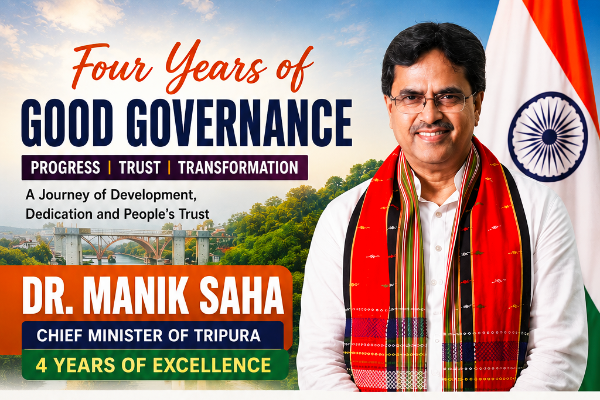
Dr. Manik Saha completed four years as Chief Minister of Tripura on May 15, marking a significant milestone that has strengthened his clean image as the people's leader.
Since assuming office on May 15, 2022, Dr. Saha has steadily built a reputation centered on clean governance, administrative discipline, and development-focused politics.
From infrastructure expansion and healthcare reforms to employment generation and law-and-order improvements or transforming socio-economic status of the people, the state government under his leadership has brought robust changes in the system over the past four years.
Political experts believe Dr. Saha’s calm image and emphasis on transparent administration played a major role in helping the BJP retain power in the 2023 Assembly elections. At a time when opposition parties attempted to unite against the ruling party, BJP managed to survive the challenge largely due to what people often describe as “Dr. Saha’s credibility factor".
Soon after taking charge as Chief Minister, he identified healthcare and education as priority sectors. The government pushed for major improvements in medical infrastructure, including strengthening district hospitals, trauma care facilities, primary health centres, and expanding services in both allopathy and homeopathy. Projects such as the Agartala Civic Hospital and the Eye Hospital also gained momentum during his tenure.
The state’s premier Govind Ballabh Pant Hospital witnessed extensive upgrades, including the introduction of multiple super-speciality services, kidney transplant facilities, and advanced healthcare systems. His administration’s healthcare push has also reportedly attracted interest from private hospital groups looking to establish branches in Agartala.
On the education front, the government completed several rounds of teacher recruitment involving TET-qualified teachers, physical education instructors, and postgraduate teachers. Preparations are also underway for STGT recruitment. Alongside recruitment, the government has laid emphasis on improving educational infrastructure through proposed institutions such as a technical university, women’s university, and medical university. The administration has also focused on strengthening Vidyajyoti Schools and Eklavya Model Residential Schools in tribal areas.
One of the major administrative challenges inherited by Dr. Saha was the long-pending JRBT recruitment process. His government resolved the issue while also addressing the concerns of government employees and pensioners. During the past four years, nearly 38 percent of pending Dearness Allowance has been cleared.
The Chief Minister has repeatedly stressed transparency in recruitment, and according to government figures, more than 22,000 youths have secured government jobs during his tenure.
Law and order has emerged as another key talking point for the government. According to NCRB data, Tripura recorded one of its lowest crime rates in two decades in 2025.
Dr. Saha adopted a “zero tolerance” policy against drugs and criminal networks, directing police agencies to take strict action.
Political insiders say this tough approach occasionally created discomfort even within sections of his own party, but the Chief Minister continued with the crackdown with backing from the central BJP leadership.
His public outreach initiative, “Mukhyamantri Samipeshu,” has also helped strengthen direct communication between the government and citizens and addrey the people's grievances.
The political significance of Dr. Saha’s leadership became more visible during the 2026 elections to the Tripura Tribal Areas Autonomous District Council.
BJP contested the elections independently after earlier fighting in alliance with IPFT in 2021, when the party had secured around 20 percent votes. Despite facing strong regional opposition, aggressive identity politics, and what party insiders described as “internal sabotage,” BJP increased its vote share to over 27 percent in the ADC elections.
Though the party could not secure power in the ADC, BJP leaders termed the rise in vote percentage as a sign of growing acceptance among tribal voters.
Sources within the party maintain that the decision to contest independently was not Dr. Saha’s personal move alone, but a collective strategy approved by the central leadership. However, allegations of internal resistance and lack of coordination in several constituencies reportedly affected BJP’s final tally.
Despite the electoral setback, the government continued to prioritize development in tribal areas. Nearly 39 percent of the state budget has reportedly been allocated toward welfare and development initiatives benefiting tribal communities.
The expansion of national highway connectivity in tribal belts, improved road and railway infrastructure, and drinking water connections reaching more than 86 percent of households have become major highlights of the administration’s development narrative. These projects, according to officials, have significantly improved connectivity and strengthened local economic activity.
Dr. Saha has also focused on investment promotion. Through roadshows and investment summits organized across the country, Tripura has reportedly received investment proposals worth nearly Rs 35,000 crore.
Despite political conspiracies, factional pressures, and external attacks, Dr. Manik Saha has emerged stronger over the years. His leadership in the 2023 Assembly polls, the 2024 Lok Sabha elections, and the BJP’s strong performance in grassroots-level rural body elections has reportedly drawn appreciation from the party’s central leadership in New Delhi.
As the road to the 2028 Assembly elections slowly begins, the people see Dr. Manik Saha as the face in Tripura — a leader determined to leave a deeper mark on the state’s political landscape despite every challenge thrown his way.