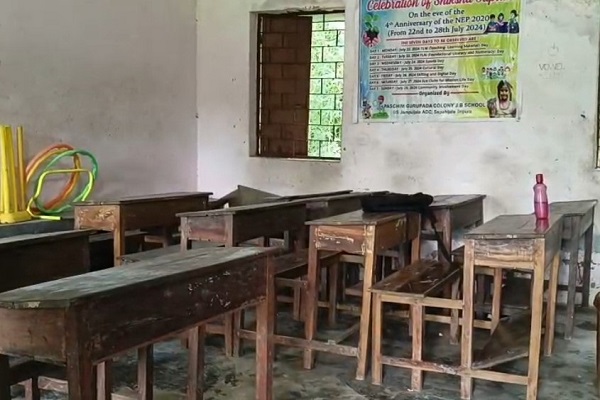
 Agartala, Aug 6: The contrasting realities emerging from two government schools in Tripura have brought into sharp focus an unusual teacher-student imbalance, with one institution having as many teachers as students while another is struggling to educate more than a hundred children with just a single teacher.
At West Gurupada Colony JB School in the Longmahaty area of Jampuijala sub-division, six teachers are currently posted against an enrolment of just six students. In stark contrast, Rangamatiya North High School under the Nalchar Inspectorate of Schools is functioning with only one teacher for 103 students from Nursery to Class VIII.
The two cases have highlighted concerns over the distribution and utilisation of teaching resources in government schools, even as several institutions continue to face challenges related to declining enrolment and shortage of teachers.
At West Gurupada Colony JB School, the situation has reached an unusual level, with no students enrolled in Classes II and III. Teachers said student attendance is also highly irregular, with some days witnessing only one child in the classroom and, on occasions, no students turning up.
Despite having adequate infrastructure and six teachers, the school has been unable to attract students in significant numbers. Local residents attributed the decline largely to the growing popularity of private English-medium schools in the area. One such institution is located next to the government school, while another is situated around 200 metres away.
Teachers have reportedly raised concerns with the authorities over the situation, including the presence and functioning of nearby private schools, but alleged that no effective action has been taken so far by the concerned education authorities.
The picture is dramatically different at Rangamatiya North High School, where a single teacher is responsible for 103 students spread across eight classes. The school had earlier been functioning with two teachers, but following the death of one teacher, the institution has been left with only one.
The lone teacher is required to handle classroom teaching as well as attendance, records, administrative duties and other responsibilities. The recent introduction of a Nursery section has further increased the workload despite the shortage of teaching staff.
According to the teacher, he had objected to starting the Nursery section because of the existing staff shortage, but the classes were introduced nevertheless. His daily responsibilities begin even before regular teaching, including opening classrooms, arranging facilities for Nursery students, taking attendance and completing official paperwork.
Parents said the teacher has been making every effort to keep the school functioning despite the enormous workload. However, they claimed that students are suffering because one teacher cannot simultaneously attend to all eight classes.
Students, too, reportedly face long waiting periods between lessons as the teacher moves from one classroom to another.
Parents and local residents have demanded immediate intervention from the Education Department and sought the posting of additional teachers and support staff. They also alleged that the school lacks basic facilities and that repeated appeals for improvement have not resulted in adequate action.
Adding to the concerns, mid-day meal workers alleged that anti-social elements enter the school campus at night, damage property and have even contaminated the school's water tank, raising questions over campus security.
The contrasting situations at the two government schools underline a larger challenge facing government education in parts of Tripura — while some schools are witnessing a severe fall in enrolment despite having teachers and infrastructure, others are struggling under acute staff shortages despite having a sizeable student population.