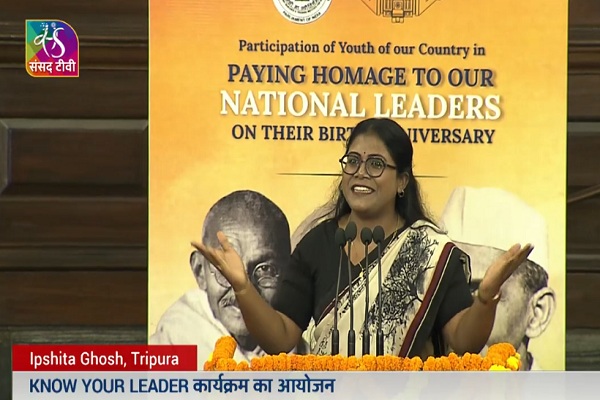
 Agartala, Oct 2: A powerful voice from Tripura resonated through the historic Central Hall of Samvidhan Sadan on Friday as young participant Ipshita Ghosh delivered a stirring address on former Prime Minister Lal Bahadur Shastri, blending history, patriotism and a call for young Indians to embrace the values of service, integrity and national unity.
She was among the youth participants from different parts of the country invited to share their perspectives on national leaders as part of the ‘Know Your Leader’ programme organised by the Parliamentary Research and Training Institute for Democracies (PRIDE) of the Lok Sabha Secretariat.
The programme was held on the occasion of the birth anniversaries of Mahatma Gandhi and Lal Bahadur Shastri, bringing together young voices at one of the country’s most historically significant parliamentary spaces.
Beginning with a tribute rooted in her home state, Ghosh said the distance between Tripura and New Delhi could not separate the younger generation from Lal Bahadur Shastri’s legacy.
Establishing the emotional tone of her address, she went on to connect Lal Bahadur Shastri’s legacy with the idea of an India where social divisions and inherited identities do not determine an individual’s aspirations.
Standing before the gathering simply as ‘Ipshita -- without titles or baggage—she described herself as a proud daughter of India and a voice representing Tripura.
She noted that young people aspiring to build a Viksit Bharat must work towards breaking down divisions that keep communities apart.
Reflecting on Shastri’s early life and political journey, Ipshita recalled his humble beginnings and the circumstances that shaped the man who would eventually lead India during one of its most challenging periods.
Her speech placed particular emphasis on three qualities she associated with Lal Bahadur Shastri’s public life — integrity, simplicity and self-reliance.
She recalled the challenges faced by India during the 1965 period of food scarcity and war, when Shastri gave the nation the enduring call of “Jai Jawan, Jai Kisan.” She also highlighted his resignation as Railway Minister following a train accident, presenting the episode as an example of accepting moral responsibility in public life.
Turning her focus towards the youth of today, Ghosh posed a question: how can Shastri’s ideals be carried forward in the journey towards a developed India?
Her answer centred on active citizenship and community service. Drawing a parallel between Shastri’s emphasis on Jawan and Kisan and the work undertaken by MY Bharat volunteers, she spoke about young people participating in crisis response, promoting modern agricultural practices and spreading digital literacy across communities.
She urged her fellow youth not to leave the historic Central Hall merely carrying memories of the occasion, but to return with a commitment to service and duty.
“Shastri ji believed that patriotism is active service, that is Kartavya,” she said, calling upon young Indians to imbibe his humility in their character, ethics in their work and determination in their purpose.
The speech concluded with a message that connected Tripura with the national stage, as Ghosh invoked the spirit of Shastri’s famous slogan and called for collective commitment to the nation.
From the green hills of Tripura to the heart of New Delhi, she said, the message should resonate across the country: “Jai Jawan, Jai Kisan, Jai Hind, Bharat Mata Ki Jai.”
Ghosh’s address at Samvidhan Sadan offered a distinctly youthful interpretation of Shastri’s legacy, linking the values of a generation that shaped independent India with the responsibilities facing the country’s young citizens today.