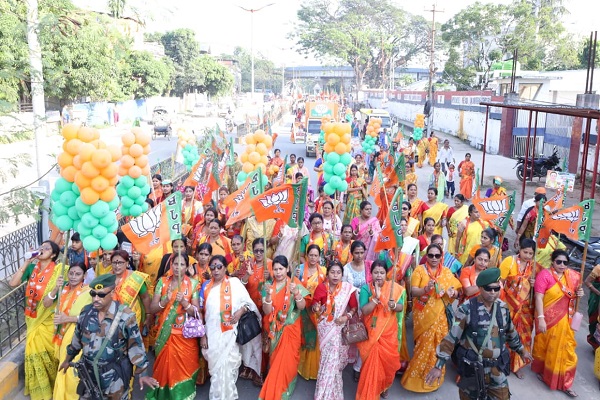
 Agartala, Nov 25: The high-voltage campaign for the November 27 Urban Local Body elections in Tripura came to an end at 4 pm on Wednesday, bringing an intense phase of political activities marked by rallies, public meetings, roadshows and door-to-door campaigning across the state.
The BJP remained highly visible throughout the campaign, organising a series of rallies, public meetings and grassroots outreach programmes in different urban bodies to reach voters ahead of polling.
From large public gatherings to door-to-door interactions, the ruling party made extensive efforts to highlight its organisational strength and civic development agenda.
According to official sources, over 5.65 lakh voters, including 2.88 lakh women, are eligible to exercise their franchise in the ULB elections across the state’s eight districts. He said that, apart from around 3000 central force personnel, nearly 7,000 personnel from the Tripura State Rifles (TSR) and state police would also be deployed across the urban areas going to polls. The SEC has also engaged 4,545 polling personnel to conduct the elections in the 16 ULBs across the state.
With the campaign period officially over, the political activity will now give way to the electoral process. Polling is scheduled across 16 urban local bodies, covering 268 seats. The BJP has already secured 77 seats unopposed, adding further significance to the remaining electoral contests.
The focus has now shifted to polling-day arrangements, security deployment and voter participation. The November 27 elections will provide an opportunity for voters to express their assessment of the competing parties and their respective promises on urban governance.
Chief Minister Dr. Manik Saha emerged as one of the most prominent campaigners for the BJP, undertaking an extensive tour across the state. From Sabroom in the south to Dharmanagar in the north, he addressed public meetings, participated in rallies and interacted with people in different urban areas. His packed campaign schedule reflected the importance the party attached to the civic elections, with the Chief Minister personally taking the lead in reaching out to voters and mobilising support for BJP nominees.
During his campaign, Dr. Saha highlighted the state government's development initiatives, welfare programmes and efforts to improve urban infrastructure. He also appealed to voters to support the BJP candidates, emphasising the need for continuity in development and coordinated efforts between the state government and urban local bodies.
BJP State President Abhishek Debroy also made noticeable efforts to strengthen the party's position across the state. He actively participated in campaign programmes, addressed party workers and voters, and focused on organisational coordination at the ward and local levels. Party leaders, elected representatives and workers were engaged in an intensive outreach exercise, seeking to take the BJP's message to every possible household.
The party's campaign also centred on its 21-point 'Sankalp Patra', which outlined a series of proposed initiatives for improving urban civic facilities. Better drainage systems, improved waste management, modern roads, underground electricity infrastructure, flyovers and other urban development projects featured prominently in its promises. The BJP sought to present the civic elections as an opportunity to accelerate the transformation of urban areas through improved planning and delivery of public services.
However, the electoral contest was far from a one-sided campaign exercise. The Congress and the CPI(M) also launched vigorous campaigns, with their leaders and party cadres making extensive efforts to reach voters before the campaigning deadline. Both opposition parties organised rallies, public meetings, processions and door-to-door campaigns in different municipalities and nagar panchayats, attempting to consolidate their respective support bases.
At the ward level, candidates and their supporters were particularly active during the final days of campaigning. Small meetings, neighbourhood visits, interactions with residents and appeals for votes became a common feature across the municipalities. Candidates made last-minute efforts to understand local grievances, explain their priorities and persuade undecided voters.