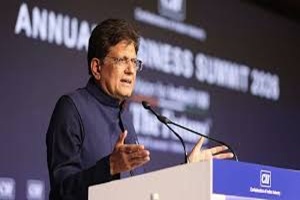
Union Minister of Commerce and Industry Shri Piyush Goyal addressed the Confederation of Indian Industry (CII) Annual Summit today in New Delhi and said that the Indian economy has continued to show resilience amid global geopolitical and economic challenges, with strong fundamentals and growing global confidence in India.
Shri Goyal said India remains the fastest-growing large economy and highlighted that the country has nearly 11 months of import cover in foreign exchange reserves. Referring to India’s export performance, he said the country is set to achieve an all-time high export figure of nearly USD 863 billion this year. He added that India’s trade deficit in goods and services together is much lower than the country’s annual remittances, reflecting strong economic performance.
The Minister said India has consistently turned crises into opportunities and noted that the country has always emerged stronger during periods of adversity. He said the current global situation should be viewed as a wake-up call for India to become more efficient, productive and self-reliant.
Referring to the vision of Atmanirbhar Bharat, Shri Goyal said the doctrine of self-reliance and confidence in Indian capabilities has remained consistent under the leadership of Prime Minister Shri Narendra Modi. He said the government and industry must work together to strengthen the India growth story.
The Minister stressed the need for Indian industry to support one another and said collective growth of Indian industry would strengthen the country’s future. He referred to earlier statements made over the years on self-reliance, quality, productivity, innovation and collective action, and said these principles continue to guide the government’s economic thinking.
Shri Goyal highlighted several initiatives aimed at improving efficiency and reducing wastage, including the LED lighting programme launched in 2015. He said energy efficiency measures have helped save nearly USD 10 billion annually in energy costs while also contributing to sustainability and environmental protection.
Calling for greater efficiency across sectors, Shri Goyal urged industry to focus on reducing waste, improving productivity and bringing down the import bill in every possible way. He said investments in public transport infrastructure, including metros and rapid rail systems, along with conscious efforts by industry and citizens, would collectively strengthen the economy.
On India’s Free Trade Agreements, Shri Goyal said the nine FTAs signed in the last three-and-a-half years with 38 countries are all with developed economies and will help India attract investments and expand exports. He said these countries complement rather than compete with India and provide access to large global markets with significant import demand.
Shri Goyal said countries such as Switzerland, the United States and nations in the European Union have much higher per capita incomes and cannot manufacture products at costs lower than India. He noted that while these economies possess strong technological and industrial capabilities, India has the advantage of competitive manufacturing and talent, which can help the country leverage these large markets more effectively.
The Minister said the FTAs are intended to strengthen India’s export capabilities, increase investments and create new opportunities for Indian businesses in global markets. He urged industry to leverage these agreements to expand their international presence and accelerate export growth.
Referring to the changing nature of global trade, Shri Goyal also said that modern trade agreements increasingly include strong mobility partnership components, reflecting the growing importance of movement of skilled professionals and services in global commerce. He highlighted that more than 10 million Indians are currently working in Gulf countries, while the number of Indians working in the UAE alone has increased from around 1.8 million to 4.5 million over the last 12-13 years, underlining India’s growing contribution to the global services economy.
The Minister urged industry to leverage artificial intelligence, robotics and quantum computing as force multipliers for growth and competitiveness. He said AI should not be viewed merely as a cost-cutting tool but as an instrument for business expansion, efficiency and market growth. Shri Goyal called upon industry bodies such as CII to deeply reflect on the transformative potential of artificial intelligence and examine areas where AI can make businesses smarter, more productive and globally competitive.
Shri Goyal advised industry to run dedicated programmes for employees to train them in smarter uses of AI and said companies should use AI to improve productivity, capture larger markets and grow businesses rather than simply reduce manpower. He added that while some sectors may face technological disruption, India has consistently adapted to changing technologies by moving from call centres to BPOs, software services and higher-end business solutions.
He further said that sectors such as hospitality, jewellery and several people-centric industries would continue to rely heavily on human creativity and skills, even in the age of artificial intelligence.
Highlighting the rapid growth of Global Capability Centres (GCCs), Shri Goyal said nearly 1,800 GCCs are already operating in India and another 500 are expected in the coming years. He said exports from GCCs are growing by nearly 40-50 per cent annually and currently stand at around USD 50 billion, employing nearly two million people directly.
Shri Goyal also pointed to emerging opportunities in sectors such as lab-grown diamonds, renewable energy-based manufacturing and artificial jewellery, saying these sectors can generate large-scale employment and create new export opportunities.
Calling upon industry to work towards achieving the target of USD 2 trillion exports over the next five to six years, Shri Goyal said the target was achievable with annual export growth of around 15 per cent. He expressed confidence in the capabilities of Indian industry and said sectors across the economy, including automobiles, steel and startups, have the potential to drive this growth through innovation, competitiveness and expansion into global markets.
The Minister concluded with a four-point call to action for industry and urged businesses to move from “assembled in India” to “designed, engineered and manufactured in India.” He called upon industry to move up the value chain, enter deeper value chains, focus on higher value addition and become self-reliant in critical components. Shri Goyal suggested that industry bodies and companies could create scorecards to measure progress in areas such as indigenisation, localisation, exports over imports and net foreign exchange earnings over the coming years.
Emphasising that quality should be non-negotiable, Shri Goyal called for a focus on “zero defect, zero effect” manufacturing and said sustainability and climate consciousness must become integral to India’s manufacturing growth story. He said Brand India should reflect high quality standards and become a global benchmark in the future.
The Minister also stressed the importance of increasing investments in research and development and innovation and called for attracting global investments in R&D to India. He urged Indian industry to bring domestic standards at par with global standards and adopt a more globally competitive outlook.
Shri Goyal further urged industry to take leadership in emerging technologies such as artificial intelligence, machine learning and quantum computing. He said that just as India led the world during the IT revolution, Indian talent has the capability to lead the world in the new-age technology era as well.