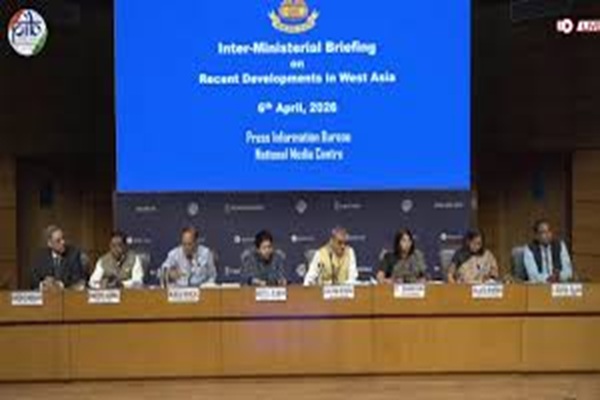
In continuation of its regular engagement with the media on the evolving situation in West Asia, the Government of India held a briefing at the National Media Centre today. Representatives from the Ministries of Petroleum and Natural Gas, Ports, Shipping and Waterways, and External Affairs, shared updates on fuel availability, maritime operations, and assistance to Indian nationals in the region, along with measures being taken to ensure stability across sectors. The Ministry of Civil Aviation also provided updates related to the aviation sector.
Aviation Sector Updates
The Ministry of Civil Aviation highlighted measures being taken to ensure continuity of services, facilitate passenger travel, and maintain coordination with airlines and relevant authorities. As per Ministry:
· The Indian aviation sector is currently navigating a serious operational and financial situation triggered by the conflict in West Asia that began in late February. The Ministry of Civil Aviation has implemented a multi-layered response to ensure passenger safety and convenience while working on keeping the industry stable.
· The Ministry of Civil Aviation is closely and continuously monitoring the evolving situation arising out of the ongoing conflict in the Western Asia region. Several countries, including Iran, Iraq, Israel, Jordan, Lebanon, Kuwait, Qatar, Bahrain, and the UAE, have imposed airspace closures or severe restrictions, leading to unprecedented disruption in global aviation networks and international connectivity.
· Despite these challenging and constrained conditions, Indian carriers have demonstrated exceptional resilience and operational agility in maintaining services from this region, which underscores the robustness and responsiveness of the aviation sector.
· However, due to the airspace restrictions, flights to Europe and North America by Indian carriers have to take longer routes, which has increased travel time.
· ATF pricing: Due to timely intervention by the Government on the pricing of Aviation Turbine Fuel (ATF), which constitutes around 40% of operational costs of airlines, domestic airfares have remained stable.
· Moreover, the Ministry, in coordination with other stakeholders, is actively engaged in working on other significant measures to support the industry.
· Operational relaxations have also been extended. Especially to manage the strain of longer routes, the Directorate General of Civil Aviation (DGCA) has temporarily relaxed pilot flight duty time limitations to prevent acute crew shortages.
· To maintain essential supply chains, foreign carriers such as Emirates, Kuwait Airways and Jazeera Airways have been granted special dispensation to operate passenger aircraft for all-cargo services. This has ensured seamless continuity of critical cargo movement despite the ongoing disruptions.
· While the situation remains dynamic, the Government remains firmly committed to ensuring passenger safety and convenience, uninterrupted cargo movement, and overall sectoral stability. The Ministry of Civil Aviation continues to work in close and continuous coordination with all stakeholders to ensure an effective, balanced and responsive approach during this period.
Energy Supply and Fuel Availability
The Ministry of Petroleum and Natural Gas shared an update on the current fuel supply situation, outlining measures being undertaken to ensure uninterrupted availability of petroleum products and LPG amid the ongoing developments affecting the Strait of Hormuz. It was noted that:
Public Advisory and Citizen Awareness
· Citizens are advised to avoid panic purchase of petrol, diesel and LPG and rely only on official sources for information.
· LPG consumers are requested to use digital booking platforms and avoid visiting distributors.
· Citizens are encouraged to use alternate fuels such as PNG and electric or induction cooktops.
· All citizens are urged to conserve energy during the current situation.
Government Preparedness and Supply Management Measures
· Despite the ongoing geopolitical situation, the Government has prioritised domestic LPG and PNG supply, particularly for hospitals and educational institutions.
· The Government has already implemented several rationalisation measures on both the supply and demand side, including enhancing refinery production, increasing the booking interval from 21 to 25 days in urban areas and up to 45 days in rural areas and prioritising sectors for supply.
· Alternate fuels such as kerosene and coal have been made available to ease pressure on LPG demand.
· The Ministry of Coal has directed Coal India and Singareni Collieries to supply additional coal to States for distribution to small and medium consumers.
· States have been advised to facilitate new PNG connections for domestic and commercial consumers.
Coordinated Efforts with States/UTs and Institutional Mechanisms
· State Governments are empowered under the Essential Commodities Act, 1955 and LPG Control Order, 2000 to monitor supply and act against hoarding and black marketing of petroleum products.
· The Government of India vide letters dated 27.03.2026 and 02.04.2026 have stressed the need for proactive public communication to reassure citizens regarding adequate fuel availability. Regular review meetings are being held with States/UTs. In this context, meetings were convened on 02.04.2026 (Chaired by Secretary, MoPNG) and on 06.04.2026 (Chaired by Secretary, MoPNG along with Secretaries of I&B and Consumer Affairs), wherein the following was emphasized:
Ø To issue daily press briefings and issue regular public advisories.
Ø To actively monitor and counter fake news / misinformation on social media.
Ø To intensify daily enforcement drives by District admin and to continue raids and inspections in coordination with OMCs
Ø To issue Commercial LPG allocation orders within their States/UTs
Ø To issue SKO allocation orders for additional SKO allotted to the States/UTs.
Ø To promote PNG adoptions and alternate fuels.
Ø To prioritise LPG supply, especially for domestic needs, and adopt targeted distribution of 5 kg FTL cylinders to ensure supply stability.
· All States/UTs have established control rooms and district monitoring committees to curb hoarding and black marketing.
· Currently, 24 States/UTs are issuing regular press briefings.
Enforcement and Monitoring Actions
· Enforcement actions continue across the country to curb hoarding and black marketing of LPG. Yesterday, more than 4300 raids were conducted, and more than 1200 cylinders were seized across the country.
· PSU Oil Marketing Companies have strengthened surprise inspections and issued over 1700 show-cause notices, imposed penalties on 168 LPG distributorships and suspended 45 distributorships.
LPG Supply
Domestic LPG Supply Status:
· LPG supply continues to be affected by the prevailing geopolitical situation.
· No dry-outs have been reported at LPG distributorships.
· Online LPG bookings have increased to about 96% across the industry.
· Delivery Authentication Code (DAC) based deliveries have increased to around 90% to prevent diversion.
· Domestic LPG cylinder deliveries remain normal.
Commercial LPG Supply and Allocation Measures:
· The Government of India vide order dated 01.04.2026 has permitted Refining companies including Petrochemical Complexes in India to make available certain minimum quantities of C3 & C4 streams for critical sectors like Department of Pharmaceuticals, Department of Food & Public Distribution, Department of Chemicals & Petro Chemicals etc. based on specific quantity and refinery source as determined by the Centre for High Technology (CHT).
· Total commercial LPG allocation has been increased to about 70% of pre-crisis levels, including 10% reform-linked allocation.
· The Government of India vide letter dated 06.04.2026 has conveyed that daily quantity of 5 Kg FTL cylinders in each State available for disbursal to migrant labourers is being doubled based on the average daily supply (Number of cylinders) to migrant labourers during 2nd-3rd March 2026 beyond the limit of 20% mentioned in letter dated 21.03.2026. These 5 Kg FTL cylinders will be at disposal of the State Government for supplying only to migrant labourers in their State with assistance of Oil Marketing Companies (OMCs).
· Since 23 March 2026, about 7.8 lakh 5-kg Free Trade LPG cylinders have been sold.
· PSU OMCs have organised around 1300 awareness camps for 5 Kg FTL Cylinders during last 4 days, wherein More than 10,000 - 5Kg FTL cylinders were also sold.
· On 06.04.2026, more than 1.06 Lakh 5 Kg FTL Cylinders were sold across the country against a daily average of 77000 in the month of Feb-26.
· A three-member committee of Executive Directors from IOCL, HPCL and BPCL is coordinating with State authorities and industry bodies to plan commercial LPG distribution.
· About 86,439 MT of commercial LPG (equivalent to over 45.5 lakh 19-kg cylinders) has been sold since 14 March 2026. Yesterday, 6530 MT of Commercial LPG (Equivalent to more than 3.4 Lakh - 19 Kg cylinders) was sold.
Natural Gas Supply and PNG Expansion Initiatives
· Priority sectors continue to receive protected supplies, including 100% supply to domestic PNG and CNG transport.
· Gas supply to operating urea plants is currently around 80 percent of their six-month average consumption, following enhancement of overall allocation to fertilizer plants to about 90 percent of their six-month average consumption from 6 April 2026.
· Gas supply to other industrial and commercial sectors, including City Gas Distribution (CGD) networks, has also been enhanced by a further 10%, effective 06.04.2026.
· CGD entities have been advised to prioritise PNG connections for commercial establishments such as hotels, restaurants and canteens.
· CGD companies including IGL, MGL, GAIL Gas and BPCL are offering incentives for domestic and commercial PNG connections.
· States/UTs and Central Ministries have been requested to expedite approvals required for expansion of CGD networks.
· The Government of India vide letter dated 18.03.2026 has offered all States/UTs additional 10% allocation of commercial LPG to States provided they can help in long term transition from LPG to PNG.
· 18 States/UTs are already receiving additional commercial LPG allocation linked to PNG expansion reforms.
· PNGRB has directed CGD entities to connect institutions such as schools, hostels, community kitchens and anganwadi kitchens through PNG within five days where pipelines are available.
· The Ministry of Road Transport & Highways has adopted an Accelerated Approval Framework for CGD infrastructure for three months to process applications on priority.
· The Government of India vide Gazette dated 24.03.2026 has notified the Natural Gas and Petroleum Products Distribution (Through Laying, Building, Operation and Expansion of Pipelines and Other Facilities) Order, 2026 under the Essential Commodities Act, 1955. The Order provides a streamlined and time-bound framework for laying and expanding pipelines across the country, addressing delays in approvals and access to land, and enabling faster development of natural gas infrastructure, including in residential areas. It is expected to accelerate PNG network growth, enhance last-mile connectivity, and support the transition to cleaner fuels, thereby strengthening energy security and advancing India’s gas-based economy.
· The Ministry of Defence has issued a short-term policy modification till 30 June 2026 to expedite PNG infrastructure installation in defence residential areas.
· PNGRB has extended the National PNG Drive 2.0 till 30 June 2026 to sustain momentum in PNG expansion.
· To encourage cleaner, more secure and self-reliant energy future, the Government of India has developed a model draft State CBG Policy. The model policy is intended to serve as a comprehensive flexible guiding framework to enable States to create their own investor-friendly and implementation-oriented ecosystem for CBG development. Those States which opt for this, will be prioritized for the next tranche of additional allocation of commercial LPG.
· Since March 2026, about 3.76 lakh PNG connections have been gasified and about 4.1 lakh additional customers have registered for new connections.
- More than 16,500 PNG consumers have surrendered their LPG connections via MYPNGD.in website.
Crude Position and Refinery Operations
· All refineries are operating at high capacity with adequate crude inventories, while sufficient stocks of petrol and diesel are being maintained.
· Domestic LPG production from refineries has been increased to support domestic consumption.
Retail Fuel Availability and pricing Measures
· Retail outlets across the country are operating normally.
· The Middle East crisis has led to an abnormal increase in crude prices; however, to protect consumers, the Government of India has reduced excise duty on petrol and diesel by ₹10 per litre.
· Export levy has been imposed at ₹21.5 per litre on diesel and ₹29.5 per litre on Aviation Turbine Fuel (ATF) to ensure adequate domestic availability.
· Retail prices of petrol and diesel remain unchanged with no increase at retail outlets.
· The Government has advised citizens not to believe rumours and requested State Governments to disseminate accurate information through press briefings.
Kerosene Availability and Distribution Measures
· An additional allocation of 48,000 KL of kerosene has been provided to States/UTs over and above regular allocation.
· The Government of India vide Gazette notification dated 29.03.2026 has facilitated distribution of PDS Superior Kerosene Oil (SKO) in PDS SKO Free States/UTs for cooking and lighting purpose only –
Ø A maximum of two PSU OMC service stations per district (preferably Company Owned Company Operated) are permitted to store up to 5,000 litres of PDS SKO.
Ø These PSU OMC service stations shall be designated by the State Government or UT administration in each district.
· 18 States/UTs have issued SKO allocation orders, while Himachal Pradesh and Ladakh have indicated no requirement.
Maritime Safety and Shipping Operations
The current maritime situation in the Persian Gulf, along with measures being undertaken to safeguard Indian vessels and crew, was also briefed. It was stated that:
· All Indian seafarers in the region are safe and no incident involving Indian-flagged vessels has been reported in the past 24 hours.
· At present, 16 Indian-flagged vessels with 433 Indian seafarers remain in the western Persian Gulf region. The Directorate General of Shipping (DG Shipping), in coordination with ship owners, RPSL agencies and Indian Missions, continues to closely monitor the situation.
· The DG Shipping Control Room remains operational 24×7 and has handled 5,342 calls and 11,053 emails since activation, including 229 calls and 406 emails in the past 24 hours.
· DG Shipping has facilitated the safe repatriation of over 1,691 Indian seafarers so far, including 92 in the last 24 hours from airports and various regional locations across the Gulf.
· Port operations across India continue normally with no congestion reported. State Maritime Boards of Gujarat, Maharashtra, Goa, Keralam, Andhra Pradesh and Puducherry have confirmed smooth functioning.
· The Ministry continues to coordinate with the Ministry of External Affairs, Indian Missions and maritime stakeholders to ensure the welfare of Indian seafarers and uninterrupted maritime operations.
Safety of Indian Nationals in the Region
Recent developments in the region, including assistance through Indian Missions, were shared during the briefing. It was informed that:
· The Ministry of External Affairs continues to closely monitor developments in the Gulf and West Asia region, with the safety, security and welfare of the Indian community remaining the highest priority.
· The Ministry remains in close coordination with State Governments and Union Territories for dissemination of advisories and coordination with Indian Missions and Consulates.
· A dedicated MEA Special Control Room continues to operate in coordination with Missions and Posts across the region to assist Indian nationals.
· Missions and Posts are maintaining 24×7 helplines and responding to queries through email and social media channels. They are issuing regular advisories with updated information on safety, local government guidelines, flight and travel status and consular services.
· Indian ambassadors are regularly engaging with Indian community associations, professional groups and Indian companies to address their concerns. Missions are facilitating visas, transit through neighbouring countries where airspace restrictions apply and providing logistical support as required.
· Welfare of Indian students in Gulf countries remains a priority, with Missions coordinating with local authorities, Indian schools, educational boards and the National Testing Agency to address academic concerns.
· Missions are also providing support to Indian seafarers in the region, including coordination with local authorities, consular assistance and facilitating requests for return to India.
· Since 28 February, around 7,60,000 passengers have travelled from the region to India.
· In the UAE, airlines continue to operate limited non-scheduled commercial flights based on operational and safety considerations, with around 90 flights expected to operate today to India.
· Flights continue to operate from various airports in Saudi Arabia and Oman to destinations in India.
· Qatar airspace remains partially open, with Qatar Airways expected to operate around 8–10 flights to India today.
· Kuwait airspace remains closed, with Jazeera Airways and Kuwait Airways operating non-scheduled flights from Dammam Airport in Saudi Arabia to India.
· Bahrain airspace remains closed, with Gulf Air operating non-scheduled flights from Dammam Airport in Saudi Arabia to India.
· The Embassy of India in Tehran has facilitated the movement of 1,862 Indian nationals from Iran to Armenia and Azerbaijan for onward travel to India, including 935 Indian students and 472 Indian fishermen.
· Due to flight restrictions and airspace closures, travel of Indian nationals continues to be facilitated through alternative transit routes:
Ø From Israel via Egypt and Jordan.
Ø From Iraq via Jordan and Saudi Arabia.
Ø From Kuwait and Bahrain via Saudi Arabia.