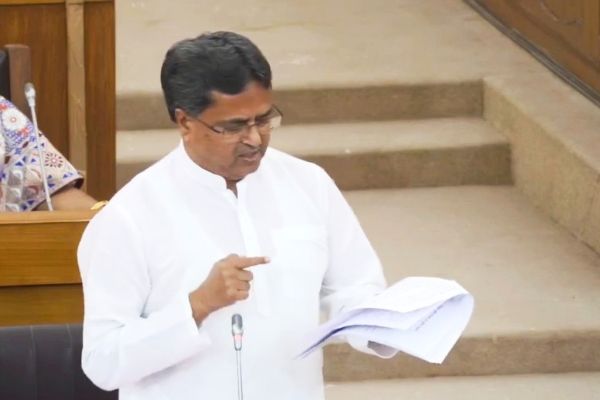
Agartala, Sept 1: The Central Government has allocated Rs 508.10 crore to Tripura under Jal Jeevan Mission 2.0 for the financial year 2026-27, Chief Minister Dr. Manik Saha informed the state Assembly on Monday.
Participating in discussions on the final day of the Assembly session on Monday, the Chief Minister said Jal Jeevan Mission 2.0 was announced in the Union Budget 2025-26 as an extended version of the Jal Jeevan Mission.
The original deadline for completion of the Jal Jeevan Mission was 2024. However, with the objective of ensuring piped drinking water supply to all rural households, the Central Government has extended the deadline under Jal Jeevan Mission 2.0 to December 2028.
According to the Chief Minister, the Centre had sanctioned Rs 368.38 crore for Tripura during 2024-25. No funds were received by the state under the scheme during 2025-26.
For 2026-27, the Centre has allocated Rs 508.10 crore, accounting for 90% of the total allocation, while the state government's share will be Rs 56.46 crore, or 10%. Thus, the total allocation for the financial year stands at Rs 564.76 crore, he said.
The funds will be released in four quarterly instalments. Of this, Rs 122.39 crore has so far been sanctioned as the first instalment.
The state expects to receive the second instalment by the last week of September 2026. The first instalment will be utilised for projects that have achieved 100% completion.
Dr. Saha said the Centre may provide additional funds to Tripura based on needs during the current financial year. He added that the concerned department was taking necessary steps to ensure easy availability of drinking water for the people.
86.50% rural households covered so far:
Providing details of the progress under the mission, the Chief Minister said piped drinking water connections have so far been provided to 6,49,500 households across rural areas of the state, including areas under Village Councils.
Before the launch of the Jal Jeevan Mission on August 15, 2019, only 3.26% of rural households in Tripura had access to household tap water connections.
At present, the state has 7,50,849 households across 606 Gram Panchayats and 587 Village Councils.
As of August 26, piped drinking water connections had been provided to 6,49,500 households, covering 86.50% of the total, the Chief Minister noted.
In the Tripura Tribal Areas Autonomous District Council (TTAADC) areas, there are 3,27,193 households, of which 2,70,714 households, or 82.74%, had received piped water connections as of August 26.
The Chief Minister made the statement in response to a Calling Attention Notice moved by MLAs Shailendra Chandra Nath and Ramu Das regarding ensuring safe and purified drinking water services across rural and hilly areas of the state.
Plans for remaining households:
To provide tap water connections to the remaining 13.50% of rural households, the state plans to implement 326 deep tube wells, 702 shallow/deep small-diameter tube wells, three surface water treatment plants, 1,498 iron removal plants and 233 innovative water supply projects across Tripura. These works are targeted for completion by 2028.
Participating in the discussion, Dr. Saha said drinking water is being supplied to rural areas through various sources, including deep tube wells, small-diameter deep tube wells, water treatment plants and innovative projects.
He noted that permanent water sources such as deep tube wells cannot be developed in some hilly areas because of scattered habitation and inadequate groundwater availability. In such locations, innovative projects based on streams, drains, reservoirs and springs are being developed.
Although such projects require additional time for completion, the Drinking Water and Sanitation Department is working in mission mode to fully implement the Jal Jeevan Mission, while also undertaking water quality monitoring, surveillance and awareness programmes.
More 1,498 iron removal plants planned:
Dr. Saha said 1,498 additional iron removal plants have been taken up to ensure that iron levels in drinking water remain within permissible limits. These projects are expected to be completed by December 2028.
The state has also ensured piped drinking water supply in 4,321 schools (96.02%) and 8,620 Anganwadi Centres (94.35%) so far.
21 water testing laboratories operational
For monitoring drinking water quality, Tripura currently has 21 water testing laboratories—one at the state level, eight at the district level and 12 at the DW&S sub-divisional level.
The laboratories are accredited by the National Accreditation Board for Testing and Calibration Laboratories (NABL). Water quality is regularly tested through these laboratories as well as through Field Test Kits (FTKs).
1,262 'Nal Jal Mitras' to be trained:
The Chief Minister further said that at least one local man or woman from every Gram Panchayat and Village Committee is being identified and trained as a 'Nal Jal Mitra' to undertake drinking water supply-related activities and maintenance at the rural level.
A total of 1,262 Nal Jal Mitras are being prepared through multi-purpose training. So far, 777 people have been trained, while the remaining 485 are planned to receive training during the 2026-27 financial year.