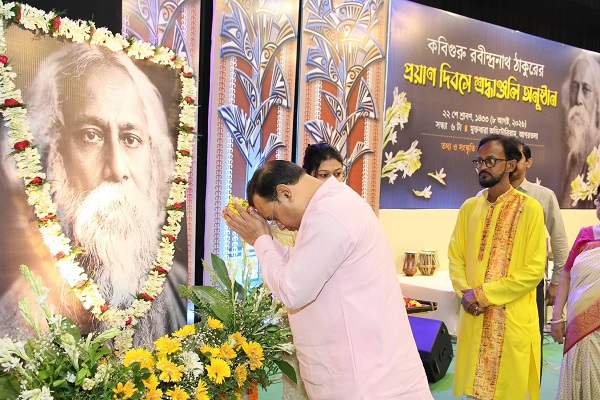
 Agartala, Aug 08: Nobel Laureate Rabindranath Tagore was not only a poet but also a renowned litterateur, social thinker, painter, and above all, a champion of universal humanism. Through his literary creations, he captivated people across the world.
Tripura Higher Education Minister Kishore Barman made these remarks while addressing a tribute programme held at Muktadhara Auditorium on the occasion of Tagore's death anniversary. The event was organized by the Department of Information and Cultural Affairs.
Speaking at the programme, the Minister said that Rabindranath Tagore is immortal, living on through our language, literature, culture, art, and national consciousness. His ideas, ideals, and creations remain as relevant today as ever.
"As long as humanity is practiced and cherished across the world, Rabindranath Tagore will continue to remain relevant," he said. The Minister noted that Tagore envisioned an India where every individual could live with dignity and where culture would serve as a symbol of self-confidence. One of his core ideals was to promote the exchange of India's knowledge and intellectual heritage with the rest of the world. He also worked tirelessly for the development of rural culture alongside urban cultural growth.
According to the Minister, modern India's journey toward becoming a developed nation is guided by many of these ideals. Highlighting Tagore's connection with Tripura, Kishore Barman said that the poet shared a close and cordial relationship with members of the Tripura's royal family.
The history of Tripura is reflected in works such as Rajarshi and Bisarjan. Through these creations, Tagore introduced Tripura to the wider world. Addressing students present at the event, the Minister emphasized that acquiring academic degrees alone is not sufficient in today's education system. Students must also develop skills in emerging fields and gain knowledge of technology while becoming responsible citizens. Such qualities, he said, would help the state and the nation progress further in education, culture, and literature.