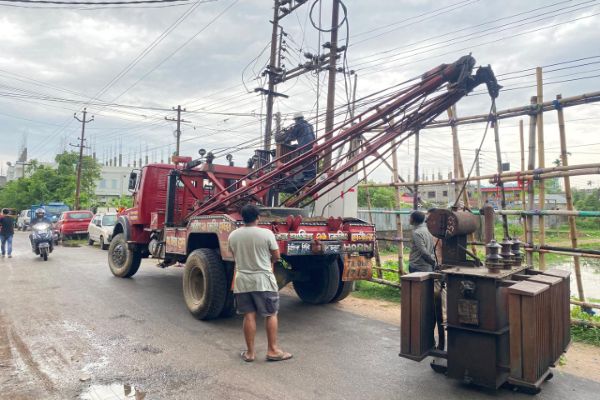
Agartala, April 29: Severe storms and heavy rainfall over the past two days have left Tripura reeling under widespread destruction.
Along with uprooted trees and damaged property, a major portion of the state’s power infrastructure has been badly affected, disrupting electricity supply across several districts.
According to the preliminary damage assessment report of the Tripura State Electricity Corporation Limited (TSECL), a total of 1,665 electric poles have collapsed across eight districts, while nearly 745.99 kilometers of power conductors have been snapped.
Additionally, 103 distribution transformers have been damaged. The estimated preliminary financial loss has been pegged at Rs 5,59,24,500.
Among all districts, South Tripura has been the worst hit, with 494 poles, 96 kilometers of wires, and 12 transformers damaged. The storm’s impact has been clearly visible in areas such as Belonia, Shantirbazar, and Sabroom.
In Sepahijala, damage includes 268 poles, 61.73 kilometers of conductors, and 15 transformers. Khowai reported 205 broken poles, while Gomati recorded 129 poles damaged and the highest number of transformer losses at 19.
In North Tripura, 173 poles were damaged, while Unakoti saw 51 poles collapse and Dhalai recorded damage to 85 poles.
In West Tripura, including the Agartala region, the damage scale has been particularly severe, with 260 poles down and 183.9 kilometers of conductors snapped.
Despite the extent of destruction, TSECL officials and ground-level workers have continued restoration operations with relentless determination.
In several areas, employees were seen rushing into the field even before the storm fully subsided, carrying wires and equipment to restore connectivity. Line workers reportedly replaced broken poles late at night amid rainfall, while engineers and technical teams worked continuously to remove fallen trees and repair damaged lines.
In many locations, staff had to work for 24 hours non-stop, and in some areas, operations extended beyond 30 hours without interruption.
TSECL sources said the restoration process became even more risky in remote hilly regions and waterlogged zones, where employees faced life-threatening conditions while reaching affected areas. However, they continued their efforts without stepping back.
TSECL Managing Director Biswajit Basu stated that the operation is not merely about restoring electricity but about reviving essential services and helping people return to normal life. He emphasized that the restoration drive is being conducted in a war-footing mode.
Power Minister Ratan Lal Nath has been personally monitoring the situation and reviewing division-wise damage reports.
Sources said he has been taking direct updates on the number of damaged poles, transformer failures, and the scope for alternative supply arrangements in each affected division. He has instructed TSECL authorities to prioritize the quickest possible restoration of electricity services for consumers.
Apart from issuing directives, the minister has also boosted the morale of the field staff by assuring them of full support from the state government. He reportedly promised all necessary assistance and administrative backing for the speedy reconstruction of damaged infrastructure.
Meanwhile, Managing Director Biswajit Basu has been actively visiting affected zones along with officials, engineers, and field teams, inspecting substations, feeders, and damaged pole lines firsthand to prepare rapid recovery plans. Employees noted that his on-ground leadership has created renewed motivation within the corporation.
The financial damage assessment also reflects alarming figures. Loss due to snapped conductors alone has been estimated at Rs 3,72,99,500, while damages to poles amount to Rs 83,25,000, and transformer-related losses stand at Rs 1,03,00,000. The total preliminary loss thus stands at Rs 5.59 crore.
However, the real impact has been felt by the common people. From Agartala city to remote villages, prolonged power outages disrupted drinking water supply, affected businesses, hampered hospital services, and caused major inconvenience in daily life.
Amid this crisis, TSECL employees have emerged as a shining example of duty and dedication, working tirelessly through storm and rain to restore essential services. The disaster has once again highlighted that electricity is not just a utility, but the backbone of modern life—and those who rebuild it during emergencies are a crucial force behind recovery.
Minister Ratan Lal Nath also expressed gratitude to the public for extending cooperation and support to electricity workers during the difficult past two days.