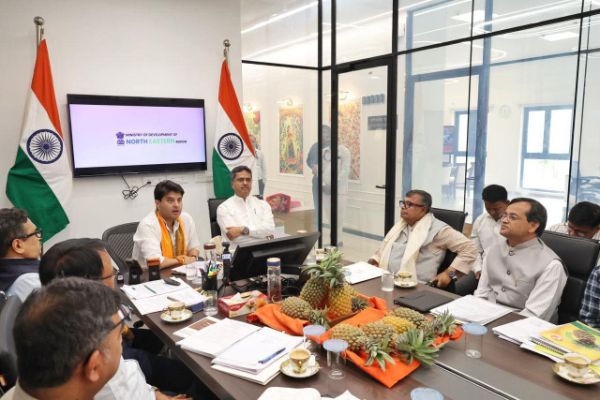
Agartala, May 27: A major initiative aimed at strengthening Tripura’s pineapple sector, Mission Queen Pineapple, was launched in New Delhi on Wednesday.
The Rs 236-crore project, spanning three years, seeks to enhance the production of the state’s famed Queen Pineapple and significantly improve the earnings of farmers.
The programme was formally launched by Union Minister for Development of North Eastern Region (DoNER) Jyotiraditya Scindia in the presence of Tripura Chief Minister Dr. Manik Saha and Agriculture and Farmers’ Welfare Minister Ratan Lal Nath during an event held in the national capital.
Chief Minister Dr Manik Saha commented, with our GI-tagged Queen Pineapple leading the way, this multi-pronged initiative will strengthen processing infrastructure, build robust market linkages, and elevate Tripura’s state fruit into a global brand.
By minimizing yield gaps and expanding export opportunities, we are committed to accelerating rural economic growth and enhancing farmers’ income, he noted.
He also extended gratitude to Prime Minister Narendra Modi for his unwavering support and visionary leadership through the Act East Policy, which continues to unlock new avenues of growth and prosperity for the Northeast.
Speaking at the launching ceremony, the Agriculture Minister said that Tripura is a land of hills and dales. About 70% of the area of the state is covered by hills and hillocks, which are called ‘Tilla’, while the remaining 30% is plain land.
“The state’s unique agro-climatic conditions make it one of India’s leading pineapple-producing regions, primarily cultivating the Queen and Kew varieties, mostly by the tribal growers of the state. The state fruit of Tripura, ‘Queen Pineapple’, holds a GI tag and is the most aromatic, golden-yellow, and low-fibre cultivar, which distinguishes it from all competing varieties. Despite this premium genetic endowment, smallholder growers in Tripura continue to receive farm gate prices of Rs 6 to Rs 10 per kg — a fraction of the Rs 80 to Rs 150 per kg that processed or export-grade Queen Pineapple can command in domestic and international markets,” he said, according to a press release.
The Minister said that pineapples grown in Tripura are widely acclaimed as the best in the country. Queen Pineapple is a spiny, golden-yellow variety known for its sweet taste, pleasant aroma, and juicy flesh, rich in vitamins A, B, and C and minerals such as calcium, magnesium, potassium, and iron, with TSS (sweetness) ranging from 13 to 17.2 degree Brix and acidity of 0.6 to 0.8%, giving it a balanced sweet-tart flavour.
“The journey of exporting Tripura’s Queen variety started on June 3, 2018, to the markets of Dubai, followed by Qatar, Oman, and Bangladesh, while canned pineapple was exported to Germany and Russia,” he said.
Speaking about the project, the Minister informed that the DPR entitled “Pineapple Cultivation and Value Chain Development” has a three-year implementation roadmap from FY 2026 to FY 2028 to systematically address every structural gap that prevents Tripura Queen Pineapple from realising its premium potential.
He said that among the Rs 236 crore project allocation, the Tripura Government will contribute Rs 20 crore, MDoNER Rs 145 crore, Rs 30 crore from the Ministry of Agriculture, Rs 25 crore from the Ministry of Food Processing Industries, Rs 4 crore from APEDA, Rs 2 crore from the Ministry of Industry and Commerce, Rs 2 crore from the MSME Ministry, and Rs 2 crore from the Indian Council of Agricultural Research.
“The DPR worth approximately Rs 236 crore has been divided into three major components including Cultivation Management, Post-Harvest Management and Processing, and Branding and Marketing. A multi-ministerial coordination model has been proposed. The Unique Selling Proposition (USP) of Tripura Queen Pineapple includes its aromatic intensity, low-fibre texture, and GI protection, which will enable it to realise its premium potential. The leaves that our pineapple farmers discard as waste today are worth Rs 1,483 crore — this scheme turns that waste into wealth, from the same land, the same crop, and the same farmer,” he said.