 Agartala, May 14: The Government of Tripura has achieved an important milestone by becoming the first State in the country to successfully complete all Priority Areas under Deregulation Phase–I and II of the national Compliance Reduction and Deregulation initiative led by the Cabinet Secretariat, Government of India.
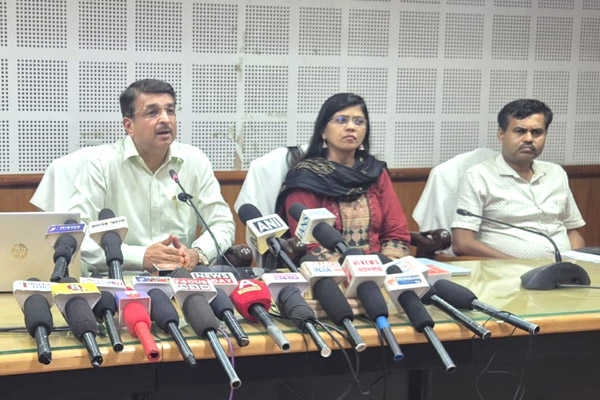
Secretary to Inidustries and Commerce department Kiran Gitte highlighted the achievement in a press conference at the Secretariat on Thursday. Director Deepak Kumar, Joint Director Debashis Das and Urban Development director Megha Jain among others were present.
The secretary said, with this achievement, Tripura become the first State in India to complete all 51 Priority Areas under both Deregulation Phase–I (23 Priority Areas) and Phase–II, (28 Priority Areas), reinforcing its position as a national frontrunner in regulatory reforms, Ease of Doing Business (EoDB) and technology-driven governance.
Tripura’s EoDB journey reflects sustained institutional commitment and measurable progress under the Business Reform Action Plan (BRAP) framework of DPIIT, Government of India. The State was recognised as a 'Top Achiever' in BRAP 2024, with 408 out of 434 reform points approved. Approval rates improved from 66% in BRAP 2022 to 94% in BRAP 2024, he noted.
Phase I Deregulation (23 Priority Areas):
Initiated in February 2025, Deregulation Phase–I covered 23 Priority Areas across Revenue, Urban Development, Industries, Labour, Environment, Factories & Boilers, Fire, Pollution Control Board and Digital Governance. The reforms focused on reducing compliance burden, eliminating redundant procedures, digitising approvals and creating a more transparent, predictable and investor-friendly regulatory ecosystem.
Land and Urban Governance Reforms: Land-related reforms reduced land use categories from over 100 to 10 and introduced flexible zoning and mixed land use. A GIS-based Industrial Land Bank was established and integrated with the India Industrial Land Bank. Construction approvals were streamlined through AutoDCR integration with the SWAAGAT Single Window Portal, along with the adoption of risk-based approvals and third-party certification.
Labour Reforms: Labour reforms enabled women to work night shifts with necessary safeguards, increased the threshold for retrenchment and closure to 300 workers, and simplified compliance under the Shops and Establishments Act.
Environmental reforms: Environmental reforms emphasised ease of compliance through self-certification, automatic renewal of Consent to Establish (CTE) and Consent to Operate (CTO), and expansion of White Category industries from 41 to 130.
Utility Reforms: Licensing processes were simplified by extending factory licence validity to 10 years, enabling auto-renewal, and rationalising trade and fire safety approvals. Utility services, including electricity and water connections, were fully digitised.
Legal reforms: Legal reforms under the Tripura Jan Vishwas Act, 2025 led to the repeal of 6 Acts, amendment of 4 Acts and decriminalisation of minor offences.
Digital governance: Digital governance initiatives included the implementation of SWAAGAT (covering 72 services and 14 inspections). Tripura became the first State to complete all Phase I Priority Areas and received commendation from the Cabinet Secretary
Phase II Deregulation (28 Priority Areas):
Initiated in January 2026, Deregulation Phase–II covered 28 Priority Areas across Revenue, Urban Development, Industries, Labour, Environment, Tourism, Health, Education and Digital Governance. The reforms focused on reducing compliance burden, eliminating redundant procedures, digitising approvals and creating a more transparent, predictable and investor-friendly regulatory ecosystem.
Land and Urban Governance Reforms: A major thrust of the reforms was simplification of land and construction approvals. The Government introduced Self- certification-based Change of Land Use (CLU) in areas conforming to Master Plans, environmental protection etc. significantly reducing procedural delays and enabling faster land utilisation. The establishment of the Single Window Approval Agency (SWAAT), rationalisation of overlapping No Objection Certificates (NOCs), introduction of self-certification mechanisms and automation of approvals for low-risk categories have substantially improved ease of approvals and reduced compliance complexity. The State also eliminated dual licensing requirements, removing regulatory duplication across sectors.
Industrial and MSME Reforms: The State introduced investor-centric reforms enabling businesses to commence operations through self-declaration mechanisms with inspection exemptions for up to three years in specified categories.
Environment and Infrastructure Reforms: The State undertook major reforms in environmental governance and infrastructure services. Environmental clearance mechanisms were strengthened through increased meetings of SEIAA and SEAC authorities, resulting in faster processing of proposals. In the power sector, mandatory field inspections for electricity connections up to prescribed limits were removed, while timelines and charges were standardised to improve service predictability and reduce delays.
Social Sector Reforms: Citizen-centric reforms were implemented across multiple social sectors. In Education, minimum land and endowment requirements for establishment of institutions were rationalised. In Health, seamless interstate registration and practice for medical professionals were enabled through a single nodal mechanism. Tourism sector reforms simplified homestay regulations through removal of multiple NOC requirements and introduction of online self-renewal systems, thereby promoting tourism entrepreneurship and local participation.
Digital Governance and Legal Reforms: As part of its digital governance agenda, the Government introduced a centralised e-Gazette system providing unified digital access to Acts, Rules, Regulations and Government Notifications. An auto-appeal mechanism under the Right to Services framework was also introduced to strengthen accountability and ensure time-bound service delivery. The Single Window System (SWAGAAT Portal) was further strengthened enhancing transparency and ease of access for businesses and citizens.
Institutional Collaborations and Reform Leadership: Tripura has emerged as a leading State in implementing institutionalised and technology-driven reforms under the deregulation initiative through collaborations with premier national institutions. The State rationalised fire safety norms in line with global best practices. The Government has collaborated with National Law University Tripura for a principle-based review of all State Acts, Rules and Government Orders to support regulatory simplification and creation of a centralised digital repository of State laws and regulations through the e-Gazette system. To assess the effectiveness of reforms implemented under Deregulation Phase–I, the Government has also empanelled Indian Institute of Management Calcutta (IIM-C) for conducting a ground-level Impact Assessment Study.
The successful completion of all Priority Areas reflects Tripura’s strong political commitment, administrative coordination and sustained focus on reform-driven governance. The reforms are expected to significantly improve investor confidence, reduce compliance costs, accelerate service delivery and strengthen Tripura’s emergence as a model State for facilitative and future-ready governance in India.
Impact of EoDB Reforms on Investment Attraction and Project Grounding:
The sustained Ease of Doing Business (EoDB) reforms particularly simplification of approvals, self-certification mechanisms, and digitisation of services have significantly improved investor confidence and reduced entry barriers. This is reflected in the signing of 394 MoUs attracting Rs. 35,140 crore in proposed investments over the past few years. Further, streamlined regulatory processes and faster clearances have enabled effective project execution, leading to 94 projects (23.8%) transitioning into grounded investments worth Rs. 5,352 crore, including major projects across healthcare, tourism, logistics, and infrastructure sectors.