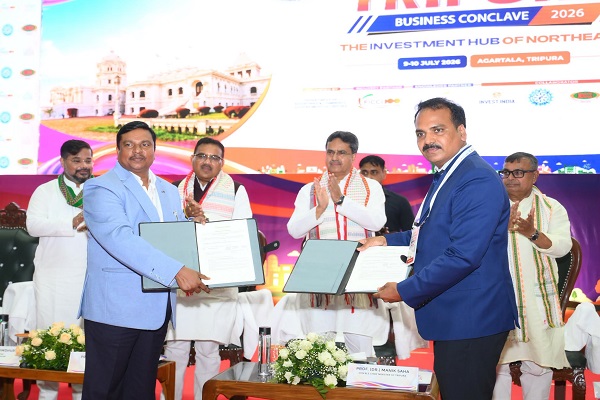
 Tripura Chief Minister Dr. Manik Saha on Thursday invited the investors to explore the opportunities in the state.
The state made a strong pitch to emerge as a preferred investment destination as the two-day Destination Tripura Business Conclave 2026 was inaugurated, aiming to attract investment proposals exceeding Rs 1 lakh crore across multiple sectors.
Addressing the inaugural session at the International Fair Ground in Hapania, Chief Minister Dr. Manik Saha said the state has created an investor-friendly ecosystem backed by progressive policies, improved infrastructure and strategic connectivity, making it an attractive destination for industries and businesses.
The event, attended by ambassadors and high commissioners of nine countries, industrialists, entrepreneurs and delegates from across India and abroad, is expected to witness the signing of over 250 Memorandums of Understanding (MoUs) involving investment intentions worth more than Rs 1 lakh crore.
According to the Chief Minister, more than 1,200 delegates are participating in the conclave, reflecting growing confidence among investors in Tripura's economic prospects.
"We are optimistic that with the coordinated efforts of Team Tripura, a significant number of these investment proposals will translate into projects on the ground, generating employment and accelerating industrial development," Dr. Saha said.
The inaugural programme was held in the virtual presence of Union Commerce and Industry Minister Piyush Goyal and Union Minister for Development of North Eastern Region (DoNER) Jyotiraditya Scindia.
He invited investors to explore opportunities in logistics, warehousing, cold-chain infrastructure, multimodal cargo hubs, electric mobility, civil aviation services, heliports, air ambulance facilities, seaplane operations at Dumbur Lake, information technology, agriculture and allied sectors.
Senior members of the state cabinet, foreign diplomats, business leaders and senior government officials also attended the inaugural session.
CM focuses on state’s achievements in various sectors:
The Chief Minister said Tripura is one of the fastest-growing states in the country. He said that the state has doubled its GSDP (Gross State Domestic Product) in just six years.
He said that, inspired by the appeal of the Prime Minister to implement the ‘Reform Express’, Tripura has secured the first rank among all the states and Union Territories in Deregulation and Compliance Reduction Phase I as well as Phase II.
“We have simplified the land-use change procedures, streamlined industrial and business permissions, built the Single Window Portal SWAAGAT, and introduced risk-based inspections. Government land is available on lease for social, educational, and commercial projects at very moderate rates. We are one of the few states that issue all industrial and business-related approvals through a single agency,” said Dr. Saha.
Dr. Saha said that during the last year, investment proposals worth more than Rs. 30,000 crore were received, out of which projects worth more than Rs. 8,000 crore have been grounded.
“We have 1,58,000 hectares of natural rubber plantations, the second largest in the country. A new Rubber Park has been set up at Santirbazar with provision for a Research & Development Centre, where quality rubber manufacturing, centrifuged latex products, foam, surgical, industrial, and household gloves can be set up. Rubberwood-based industries, including plywood and veneer manufacturing, and biochar plants using rubberwood waste are new investment opportunities.
Similarly, we are expanding industrial bamboo cultivation to 45,000 hectares and setting up an integrated bamboo value chain park in Unakoti. With 2.27 crore agar trees, Tripura has India’s leading and most credible agar ecosystem,” said Dr. Saha.
He said that investment opportunities are available in agar inoculum, agar oil distillation units, attar and perfume manufacturing, hydrosol, and wellness products.
“In agriculture and horticulture, potential investment areas are the establishment of cold chain infrastructure, tissue culture facilities, processing of pineapple and jackfruit, fibre extraction, dehydrated fruit processing, and rice husk and bran oil units. There is ample scope for establishing fish feed manufacturing plants, cluster-based fish farming, fermented and dried fish processing, fish markets and transhipment yards, and aqua tourism. We are building an energy ecosystem that is sustainable, technology-driven, and investment-friendly,” said Dr. Saha.
He said that the strategic location of Tripura, with its 856-km border with Bangladesh, makes it the gateway to Southeast Asia.
“Agartala–Akhaura International Rail Link, development of Maharaja Bir Bikram Airport as an international airport, Maitri Setu connecting Sabroom to Chattogram Port, and the Sonamura–Daudkandi Inland Water Transport route to Kolkata and Haldia ports through Bangladesh are real opportunities for a seamless multimodal transport and logistics ecosystem. Tripura offers immense opportunities in logistics parks, warehousing, cold-chain infrastructure, multimodal cargo hubs, electric mobility, commercial pilot training and aircraft maintenance engineering, heliports and air ambulance services, and seaplane operations at Dumbur Lake,” he said.
Dr. Saha said that the Government of Tripura is committed to transforming the state into a leading hub for healthcare, pharmaceuticals, biotechnology, and medical innovation.
He said that major infrastructure projects such as the Tripura IT & Data Ecosystem Zone (TIDEZ), the Innovation & Incubation Park, and a state-of-the-art IT Park are being developed to enable businesses to scale with confidence.
On the sidelines of the conclave, the Chief Minister and several cabinet ministers held one-on-one meetings with industry leaders and international delegates to showcase Tripura's investment policies and sector-specific opportunities.
Dr. Saha said discussions with representatives of the Bangladesh High Commission focused on strengthening cross-border trade and exports, while interactions with business leaders highlighted the state's incentives and policy framework designed to facilitate new investments.