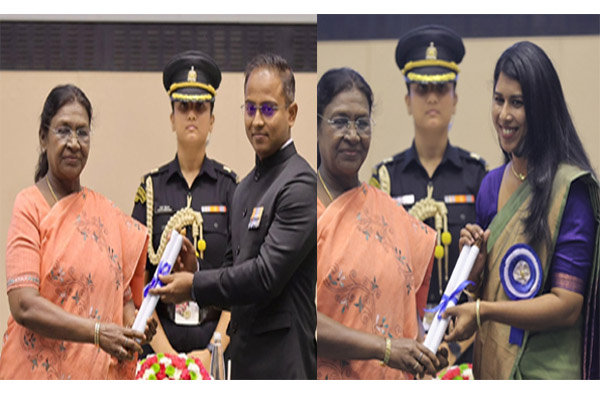
 In a proud moment, Tripura's two districts- North Tripura and Sepahijala were honoured with the National Water Awards.
The awards, conferred by President Droupadi Murmu on November 18, 2025, at Vigyan Bhavan, New Delhi, spotlighted the innovative and dedicated work of the local administrations in addressing water scarcity and improving water management practices.
North Tripura, celebrated for its outstanding performance in water conservation, was awarded the "Best Performing District in the North East & Hilly Zone" under the Jal Sanchay Jan Bhagidari (JSJB) Campaign. The district earned this recognition after successfully creating over 11,000 water conservation structures between February and May 2025.
The efforts were led by the North Tripura District Administration, with support from local officials, public representatives, and the community. The district was also honoured with Rs 2 crore award.
Sepahijala District, also from Tripura, was the sole district from the North Eastern region to receive a national award for its water conservation initiatives. The district's proactive approach to improving water availability and quality was recognized with the prestigious Best District Award in the region.
Besides Sepahijala (Tripura), the best district award was given by the President to Rajnandgaon (Chhattisgarh), Khargone (Madhya Pradesh), Mirzapur (Uttar Pradesh), Tirunelveli (Tamil Nadu) -- with each topping their respective zones.
The awards, instituted in 2018, aim to showcase best practices and motivate communities, institutions and industries to adopt measures that contribute to a Jal Samriddh Bharat (water prosperous India).
Maharashtra secured the best state award in water conservation, followed by Gujarat and Haryana, according to an official statement.
Giving away the sixth National Water Awards, President Murmu urged private persons and public bodies to treat water as a sacred and finite national resource.
She said sustainable management and community participation were essential to ensure long-term water security, as she cautioned that India faces growing stress on its limited freshwater reserves.
"Thousands of years ago, our forefathers said in the Rig Veda, apsu antah amritam (there is immortality in water)," she said.
"Water is life. A person can live a few days without food, but not without water. We must remember that we are using a very valuable resource," she said and urged citizens, institutions and governments to treat water as a "sacred and finite national resource."
The president lauded the 46 awardees across 10 categories for their work in conservation, innovation, and efficient water use. "I congratulate all the individuals and organisations who have received this award today. You are working hard for water, and your efforts are crucial for our nation," she said.
Murmu said climate change is disrupting the water cycle, intensifying pressure on already limited water resources. "In such a situation, the government and the people should work together to ensure water availability and water security," she said, and underlined the need to preserve groundwater, promote a circular water economy, and strengthen reuse and recycling across industries.
Murmu cited the Jal Jeevan Mission's expansion of household tap water connections as a major shift in India's water landscape. "In 2019, less than 17 per cent of homes had tap water. Today, that number has increased to 81 per cent. Women and girls have benefited the most, with nearly 9 crore women relieved from the daily burden of fetching water," she said, stressing that supply must be accompanied by responsible usage.
Comparing water to financial savings, the president said communities must "deposit before withdrawing," recharging local sources to sustainably draw from them. "Families who use tap water wisely are safe from economic problems. Communities that use water wisely will always be safe from water shortages," she said. Murmu called for "lifelong water stewardship," reminding that India's water heritage is deeply connected to its cultural identity.
"People and communities should use water with great respect. Only with the collective participation of families, society and the government can sustainable water management be achieved," she added.